


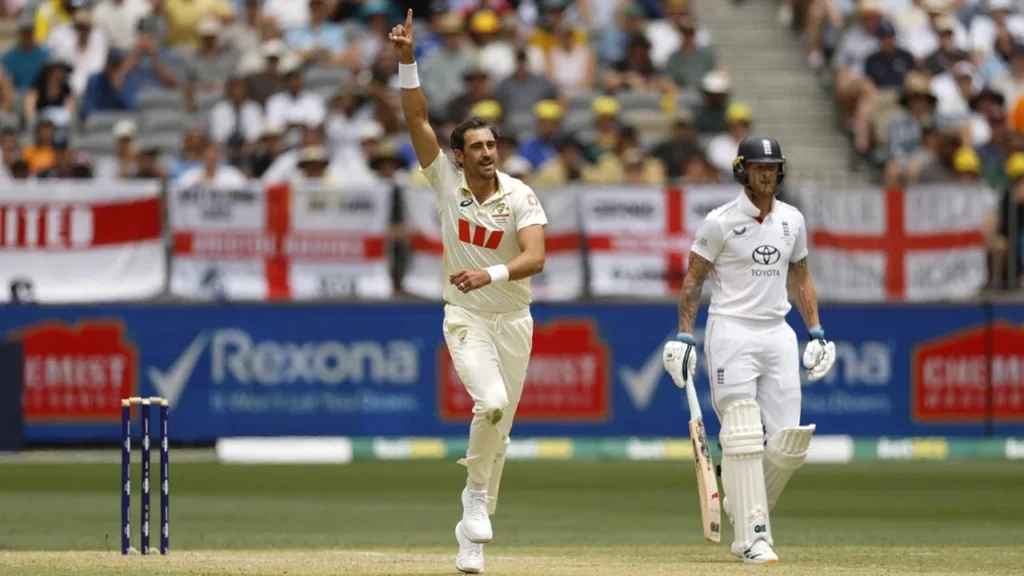
Australia fast bowler Mitchell Starc raised concerns about the Decision Review System technology after the third Ashes 2025-26 Test against England. Mitchell Starc said the ICC should take responsibility for the many controversial moments involving real-time snickers during the Ashes, especially in the Adelaide Test.
Tension grew over real-time snickers during the Ashes. England lost the match on review after match referee Jeff Crowe admitted that Alex Carey was wrongly saved on the first day due to operator error. The entry of Snico providers, BBG Sports, raised questions about the reliability of the system.
The controversy continued into the second day and Starc was later heard criticizing the technique on the stump mic. In particular, the ECB and Cricket Australia are expected to lobby the ICC on these DRS issues.


Why doesn’t ICC pay for this?” Mitchell Starc on DRS amid Snicko’s complaints
Mitchell Starc said that the ICC should take full responsibility for the decision review system. The Australian fast bowler said the ICC should fund DRS worldwide and rely on a single technology provider for all international matches, thereby ensuring continuity across different series.
Mitchell Starc said, “I’m sure it’s disappointing for everyone, spectators, officials, broadcasters, there’s no doubt about that.” “One thing I will say… I’m only going to speak for myself here, the officials use it, right? So why doesn’t the ICC pay for it?”
“And why isn’t it the only one [provider] across the board? Why don’t we use the same technique in all the different series that would perhaps create less confusion, less frustration? So I’ll leave it at that,” Michelle Stark said.
It doesn’t feel super consistent sometimes – Pat Cummins
Australia captain Pat Cummins said there were notable differences in technique. He said that the system used in the Ashes series did not always resemble the UltraEdge seen in other countries, which created skepticism among players.
“The stuff here sometimes seems a little different to the stuff you get overseas,” Cummins said. “There’s always some murmurings. If you’re a bowling team, you’re hoping it matches up.”
“Sometimes you just make sure everything is OK if you’re batting, even if you feel like you haven’t hit the ball. Sometimes it doesn’t seem super consistent, but whatever the umpire says you just pay attention to it,” he said.
RTS and UltraEdge use under the spotlight during Ashes
The International Cricket Council currently approves two sound-based systems: Real Time Snico (RTS), which is used in Australia, and UltraEdge, which is used in most other countries. Notably, the ICC pays for ultras during the World Cup and major global events, but not for bilateral Test series.
Former Australian captain Ricky Ponting criticized RTS during the third Test. He said that umpires cannot rely on it and said that UltraEdge works better. UltraEdge is used in the Big Bash League and most international matches around the world.
The technology cannot be changed during a series, meaning RTS will continue to be used for the remaining Tests in Melbourne and Sydney. Australia have already retained the Ashes by winning the third Test in Adelaide and will next face England in the Boxing Day Test at the MCG from December 26.
Also read: Travis Head destroys Stuart Broad in four-word slur after Australia retain Ashes