
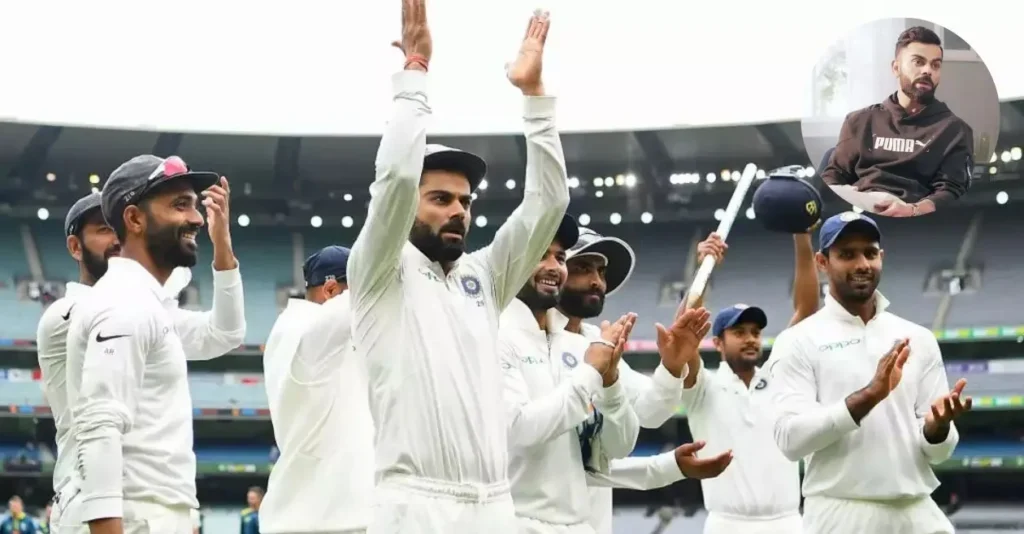

In a candid reflection on the most transformative period in Indian Test history, Virat Kohli Recently he revealed the secret behind his team’s unprecedented success. Speaking on the RCB Podcast, the 37-year-old batting icon, who made the transition from the longest format last year, highlighted that the team’s golden era was built not just on talent but on a unique demographic alignment that fostered a culture of collective ownership.
Kohli, India’s most successful Test captain with 40 wins in 68 matches, said the core group he led included stalwarts like. Ajinkya Rahane, Cheteshwar PujaraAnd Ravichandran AshwinEntered their peak together. The lack of traditional hierarchy allowed a group of friends to eliminate the rigid senior-junior divide that often characterizes international dressing rooms.
Virat Kohli reveals how a young Test team created better accountability and shared ownership
According to Kohli, the relatively lower average age of the team during his tenure (2014-2022) was a catalyst for tactical and mental change. When Kohli took command ms dhoniHe inherited a group of players who were largely in their mid-20s. This shared timeline meant that the younger players each felt empowered to contribute to the direction of the team, rather than waiting for ‘orders’ from veterans.
“There was no hesitation between senior and junior, Because of the average age of the group, everyone felt like they had responsibilities and ownership. It wasn’t like, ‘These guys will take care of the team and we have nothing to do with it.’Kohli reflected.
This psychological shift caused players to ask themselves an important question: “What can I do to improve the team?This internal accountability gave rise to the pace quartet revolution, where bowlers like Mohammed Shami, Ishant Sharma, Umesh Yadav And Jasprit Bumrah Driven by a shared vision of becoming the world’s most dangerous bowling unit, the pack hunted.
See also: Virat Kohli’s funny comment on stump mic during RCB vs KKR match goes viral
‘SENA’s’ triumph and tactical intensity is Kohli’s legacy
The results of this “youth-led ownership” are in the record books. India won the historic series for the first time under Kohli’s leadership. Australia (2018–19) and achieved seven Test wins in SENA countries (South Africa, England, New Zealand, Australia), the most for any Asian captain.
Beyond the trophies, Kohli’s legacy is defined by his passion for fitness and aggression. By bridging the age difference, he was able to implement a high-octane environment that required elite athleticism. Ashwin- Ravindra Jadeja The spin pair dominated on home soil, while the pace battery ensured India remained competitive on the fast, bouncy pitches of the southern hemisphere.
As the baton now passes to the next generation Shubman Gill Leading a new-look team after the retirement of the ‘Ro-Ko’ (Rohit-Kohli) era, Kohli’s ideas serve as a blueprint. His tenure proved that when a team moves away from the shadow of individual superstars and towards a model of shared responsibility, they don’t just win matches; They changed the culture of the game forever.
Kohli ended his illustrious Test career as India’s fourth-highest run-scorer (9,230 runs), but as he suggests, his greatest contribution may have been the fearless, ‘flat’ hierarchy he created within the dressing room.
Also read: Top 5 batsmen fastest to complete 14,000 T20 runs. Virat Kohli
