


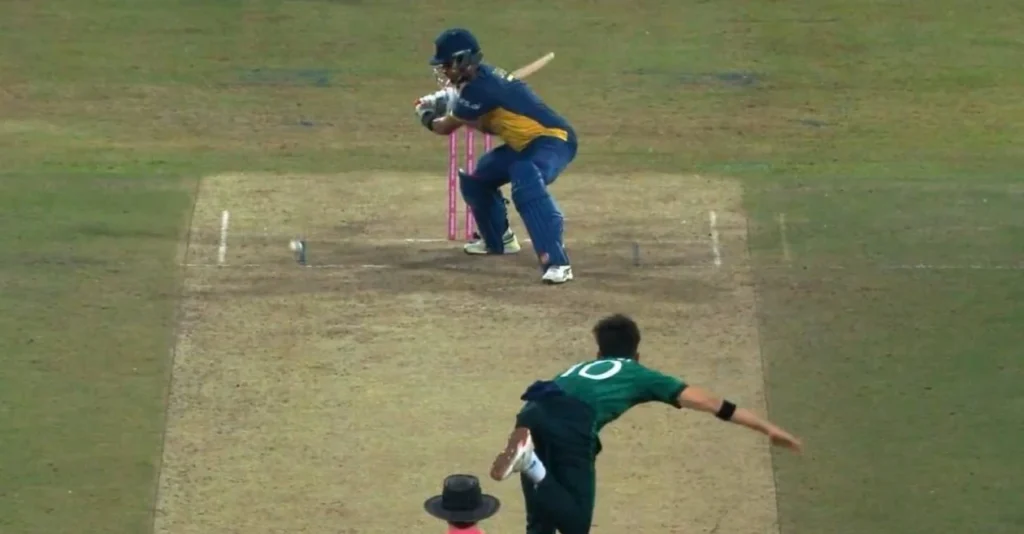


In one of the most dramatic finales of ICC Men’s T20 World Cup 2026Pakistan’s five-run win over co-hosts Sri Lanka was overshadowed by a major umpiring controversy over the final delivery at the Pallekele International Stadium on Saturday. The match ended in controversial circumstances when Sri Lankan captain Dasun Shanaka left the last ball in the hope of a wide call, which never came, sparking heated debate in the cricket world.
Dasun Shanaka’s heroic attack against Pakistan falls short
chasing a tough target of 213Sri Lanka needed 28 runs in the last over bowled by Pakistan fast bowler Shaheen Shah Afridi. What happened next was pure mayhem. Shanaka, who was already on 58 off 27 balls, hit three consecutive sixes on the second, third and fourth balls, reducing the equation to six runs required on the last two balls and sending the home crowd into frenzy.
The fifth ball proved important. Afridi bowled a low full toss outside the off stump. Shanaka attempted an ambitious scoop but missed it completely. He immediately appealed for wide, believing the ball was beyond the tramline, but umpire Rod Tucker remained adamant.
Controversial final delivery
With a six still needed on the last ball, the tension reached its peak. Afridi bowled another low full-toss, this time it landed on the off-side tramline – the painted blue line indicating wide. Shanaka left it alone, fully expecting the umpire to signal wide, which would have given Sri Lanka another delivery, with six still needed. When no signal came, Pakistan broke into celebration, while the Sri Lankan players stood in disbelief.
Television replays showed that the ball was pitched on or off the designated wide line, leading fans and experts to question why the decision was not mentioned or reviewed.
Why was it not given wide?
According to the laws of cricket, the wide line ultimately falls under the discretion of the umpire. As the Free Press Journal explained, when a ball pitches over the blue wide line, the umpire has the authority to call it wide or consider it a legal delivery – both decisions would technically be within the rules. In this instance, umpire Tucker decided against giving the wide signal, a call that effectively ended Sri Lanka’s miraculous comeback attempt.
Sri Lankan head coach reacts angrily to on-field umpire
The controversy did not end on the field. Live footage showed Sri Lanka head coach Sanath Jayasuriya confronting umpire Rod Tucker immediately after the match, gesturing angrily and questioning why the last two balls were not called wide. Jayasuriya was seen watching the replays on the big screen, shaking his head in disbelief at the decision that denied his team a potential win.
Shanaka, who remained unbeaten on 76 off just 31 balls with the help of eight sixes and two fours, closed his eyes in disappointment before acknowledging the crowd’s support. Their heroic effort – almost one of the greatest chases in T20 World Cup history – ultimately went in vain.
Also read: IND vs WI, T20 World Cup 2026 Super 8 – Hourly Weather Forecast for Kolkata
Despite victory over Sri Lanka, Pakistan faced elimination
The irony of the situation was not lost on observers. Despite achieving the win, Pakistan were eliminated from the tournament as they failed to restrict Sri Lanka to below 147 – the target required to surpass New Zealand’s net run rate and qualify for the semi-finals. Instead New Zealand progressed, celebrating their fortunes from their team hotel in Colombo.
The match featured notable performances, including Sahibzada Farhan’s historic second century of the tournament (100 off 60 balls) and his record 176-run opening partnership with Fakhar Zaman (84 off 42 balls) – the highest for any wicket in T20 World Cup history. Farhan also surpassed Virat Kohli’s 12-year-old record of most runs in a T20 World Cup edition with 383 runs.
The umpiring decision sparked a heated debate on social media platforms. Fans posted side-by-side photographs in which the trajectory of the final ball was clearly visible outside the off-stump line, with many questioning why the third umpire did not intervene. Some users sarcastically suggested “Even the umpires were paid,” While others debated whether Sri Lanka should have reviewed the call. The controversy added another layer of drama to what was already a suitably chaotic end to Pakistan’s turbulent campaign.