


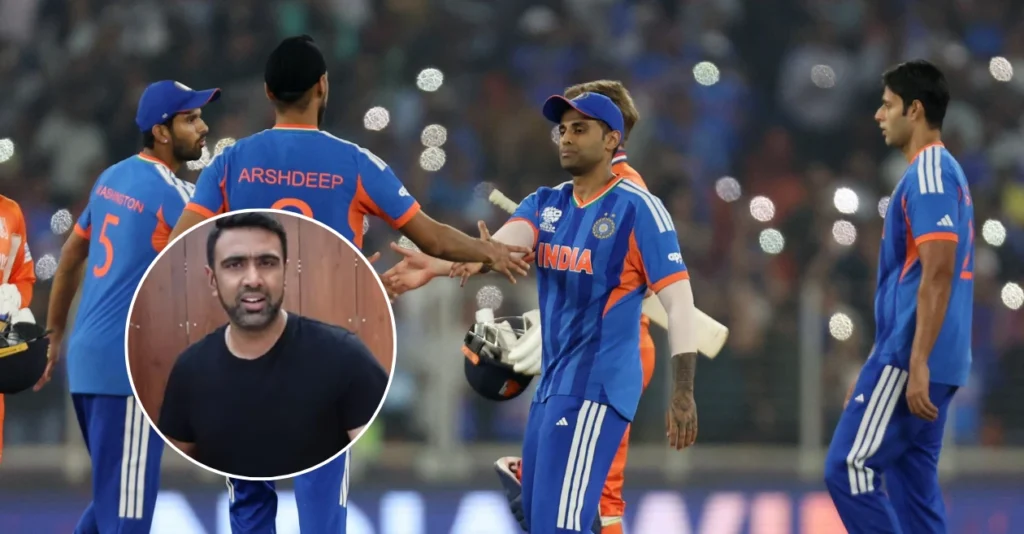


As India enters the Super 8 stage ICC Men’s T20 World Cup 2026 With an unbeaten record, former off-spinner Ravichandran Ashwin has provided a detailed assessment of the defending champions’ form, highlighting both concerns and encouraging signs ahead of their crucial clash against South Africa on February 22. Through his YouTube channel ‘Aish Ki Baat’, Ashwin has provided astute insights on the team’s performance, selection dilemmas and the challenges faced in the crucial phase of the tournament.
India’s best record: the good, the bad and the unconvincing
India completed the group stage with four comprehensive wins, topping Group A with wins against the United States, Namibia, Pakistan and the Netherlands. However, Ashwin believes that the team is not firing on all cylinders yet, especially with the bat. This is how he described India’s batting performance after their 17-run win over Netherlands in Ahmedabad on 18 February. “Below Par” Despite victory.
“India were not very good with the bat today, not very efficient. But this is such a strong team that even on a normal day, they can beat you. They were below their level, not at their best.” Ashwin saw. The assessment assumes significance given India’s reputation as tournament favorites and the high standards they have set since winning the 2024 T20 World Cup.
Abhishek Sharma’s look: The elephant in the room
The biggest concern in Super 8 is the poor form of opener Abhishek Sharma. The left-handed batsman has set a record of being dismissed for three consecutive ducks in the tournament, making him the first Indian opener to achieve this unwanted feat in T20 World Cup history. Against the Netherlands, he was bowled by off-spinner Aryan Dutt, causing further concern.
Despite these setbacks, Ashwin has strongly advocated patience and insisted that it would be a mistake to drop Abhishek. “This is Abhishek’s game. It happens. He was also not okay. He has scored runs, it is not like that. It is not like you will drop him from the team right now. When he is in rhythm, he wins games for India within the powerplay.” He said.
Ashwin has identified a clear tactical pattern which opposition teams are exploiting against Abhishek. Off spinners are being deployed at the start of their innings, bowling a tight line which limits their ability to free their arms and clear their front foot for big swings.
“Abhishek cleared his front foot and tried to swing. So bowling off-spinner has become a trend now. When we played RR vs SRH, I bowled 3 overs in a row and didn’t bowl much. They had to get out but narrowly escaped. It is becoming a trend. They are trying to bowl tight lines. Because it is close, it is not in their range.” Ashwin explained.
The experienced spinner is confident that this is not a technical glitch but a temporary glitch. “It’s not a technical glitch. Abhishek always played like that. But it can get to your mind. But I really hope he scores some runs, and he has to do well. He’s got three not outs in a row, but that doesn’t change how lethal a batsman he is in T20 cricket.” He added.
Batting depth: India’s biggest strength
Despite concerns about top-order continuity, Ashwin highlighted India’s exceptional batting depth as a key advantage. Against the Netherlands, when Suryakumar Yadav and Tilak Verma struggled to find pace, the middle order withstood the pressure and performed well.
“Surya played a very hard-working innings. For the acceleration point, Dubey, Hardik and Rinku were there. They knew they could hold the scoring rate.” Ashwin said while appreciating the responsible attitude of captain Suryakumar Yadav.
Shivam Dubey’s innings of 66 off 31 balls and the platform provided by Hardik Pandya’s cameo ensured India reached a competitive score, showing that even on an off day, this batting unit has remarkable resilience.
Role of Tilak Verma: Control of time over power
One of the more subtle points raised by Ashwin was the importance of recognizing different batting styles within the lineup. Tilak Verma, returning from injury, has faced criticism for not matching the power-hitting of his teammates. Ashwin offered a subtle defence.
“Tilak Verma is coming back after injury. We talk about power and strength, but also about sweet spot and timing as the basic essence of batting. Tilak is not a big power hitter. Timing and sweet spot are most important for him. Please remember that you can play like Vaibhav, but you can also play like Tilak, who relies on timing and picks the intervals.” he explained.
This insight reflects the tactical flexibility that India possesses – the ability to adapt the approach depending on match conditions rather than rigidly follow a power-hitting template.
Bowling power: the unsung hero
While batting concerns dominate the discussion, India’s bowling attack has been consistently excellent throughout the group stage. The return of Kuldeep Yadav has added variety to the spin department, which already has Varun Chakravarthy and Axar Patel.
Kuldeep is on the verge of becoming India’s highest wicket-taker spinner in T20Is, needing just two wickets to surpass Yuzvendra Chahal’s tally of 96 wickets. His ability to extract turn and bounce even on flat surfaces makes him a potent weapon in the Super 8, where the matches will be played on diverse Indian pitches.
Also read: Dinesh Karthik settles Virat Kohli vs Babar Azam ‘legendary batsman’ debate with a candid comment
Jasprit Bumrah’s accuracy and Hardik Pandya’s incisive medium pace complete a good attack which Ashwin believes can defend any total.
India’s competition in Super 8 round
India’s Super 8 campaign begins on February 22 with a blockbuster clash against South Africa at the Narendra Modi Stadium in Ahmedabad – a rematch of the 2024 T20 World Cup final. They will then face Zimbabwe in Chennai on February 26 before concluding the group stage against West Indies in Kolkata on March 1.
Also read: Hardik Pandya’s romantic birthday wish for girlfriend Maheeka Sharma takes the internet by storm