


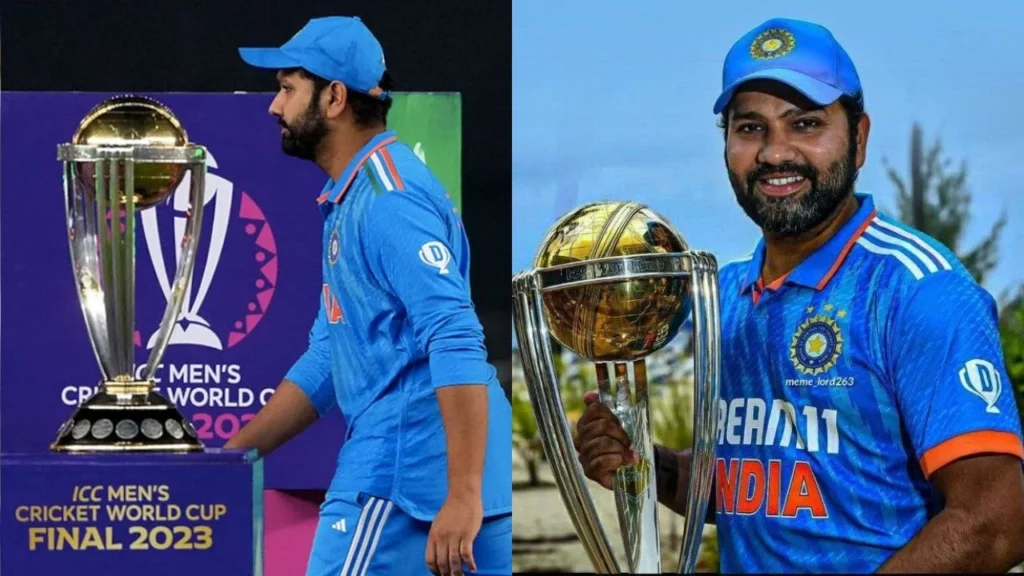
In the last few weeks, the debate regarding Rohit Sharma’s ODI future has intensified. With him being over 40 by the time the 2027 ODI World Cup begins, many believe that India should start planning for the future and invest in young opening options.
This argument makes sense on the surface because international teams rarely carry older players into a World Cup cycle, especially when they are trying to build for the next generation. Recent ODI form, fitness and long-term plans will all be factors when the selectors ultimately select India’s squad.
Nevertheless, there is another side to the discussion and it cannot be dismissed because of age. In the history of the ODI World Cup, few cricketers have consistently raised their game like Rohit on the game’s biggest stage. In three editions, he has rewritten batting records, played match-winning innings with remarkable regularity and established himself as one of the game’s greatest World Cup batsmen.
And this raises an important question. Should India ignore one of the greatest ever ODI World Cup performers simply because of his age? The answer cannot come from emotion alone. It has to come from evidence. And when the statistics are examined, Rohit’s World Cup resume stands up with the best in cricket history. Recently Morne Morkel had dismissed the rumors of Rohit Sharma’s retirement before Lord’s ODI.
key points
- Rohit Sharma holds several all-time batting records in the ODI World Cup.
- His seven World Cup centuries are the most by any batsman in the history of the tournament.
- He has won seven Player of the Match awards, second only to Sachin Tendulkar.
- Rohit has been one of India’s top two run-scorers in three consecutive World Cups.
No batsman has scored more centuries than Rohit Sharma in the ODI World Cup.
If one statistic defines Rohit Sharma’s World Cup record, it is this: No batsman has scored more centuries in ODI World Cup history.
In just 28 World Cup matches, Rohit has scored seven centuries and left behind legends like Sachin Tendulkar, David Warner, Kumar Sangakkara, Ricky Ponting and Virat Kohli.
Sachin Tendulkar needed 45 World Cup matches to score six centuries. David Warner reached six centuries in 29 matches. Virat Kohli has five centuries in 37 matches, while Sangakkara and Ponting also finished with five centuries each. Meanwhile, Rohit Sharma surpassed all of them in just 28 matches.
His World Cup career of 1,575 runs at an average above 60 and a strike rate of over 105 underlines not only longevity but also continued excellence against the strongest attacks in world cricket. Very few players have combined volume with match-winning impact as Rohit Sharma has done on the biggest ODI stage.
Rohit Sharma’s five centuries in the 2019 World Cup remain an unmatched record.
The 2019 ODI World Cup also stands out among the notable achievements of Rohit Sharma. The Indian opening batsman produced one of the greatest batting campaigns in a World Cup, scoring 648 runs including five centuries.
No batsman in the history of the tournament has been able to match that achievement. Quinton de Kock was the closest with four centuries during the 2023 World Cup, while Kumar Sangakkara also managed to score four centuries in 2015. Still no one could match Rohit’s unprecedented five centuries.
Consistency made this achievement even more special.
His centuries came against South Africa, Pakistan, England, Bangladesh and Sri Lanka, revealing his ability to adapt to different bowling attacks and match situations in the competition.
Those innings became the backbone of India reaching the semi-finals. Even today, whenever there is a discussion about the best individual batting campaigns of the World Cup, Rohit’s 2019 performances inevitably figure in the conversation. This is one of the strongest evidence supporting his extraordinary Rohit Sharma ODI World Cup statistics.
Rohit Sharma has played more match-winning innings in the World Cup than almost anyone else
Running alone doesn’t always tell the whole story. Sometimes, the greatest measure of a player’s World Cup impact is how many times he leaves the field with a Player of the Match award.
Here too Rohit Sharma’s figures are extraordinary. He has won seven Player of the Match awards in the ODI World Cup, second only to Sachin Tendulkar’s nine awards.
This difference becomes even more pronounced when compared to other giants. Australia’s great Glenn McGrath, regarded as one of the greatest World Cup bowlers of all time, won five such awards in 39 matches.
Among India’s current players, Rohit Sharma has won as many 50-over World Cup Player of the Match awards as the rest of the players in the current Indian team combined.
Whether through explosive starts, match-defining centuries or commanding chases, he has time and again been the player who has shaped the outcome of World Cup competitions.
Rohit Sharma’s seven awards have come in just 28 appearances and shows how often India have relied on him when the stakes were highest.
India’s World Cup batting has revolved around Rohit in all three editions
Perhaps the strongest argument in favor of Rohit Sharma’s World Cup pedigree is his remarkable consistency across multiple tournaments.
India’s batting line-up has evolved significantly since 2015. Players have retired, captains have changed and the batting order has been shuffled. Yet one constant remains. Rohit Sharma has consistently been one of India’s leading run-scorers.
Only Shikhar Dhawan scored the most runs for India in the 2015 World Cup. Dhawan scored 412 runs, while Rohit made an impressive contribution of 330 runs.
Four years later in England, Rohit completely dominated the tournament with 648 runs, comfortably ahead of Virat Kohli, who scored 443 runs.
Then came the 2023 World Cup, where Virat Kohli’s record-breaking 765 runs topped India’s charts, but Rohit once again finished second with 597 runs, playing a very different role as the team’s ultra-aggressive opening batsman. In three consecutive World Cups, Rohit Sharma never finished among India’s top two run-scorers.
That level of consistency over almost a decade is exceptionally rare. This also explains why India’s batting plans often revolve around him. Regardless of the role assigned, Rohit Sharma has continued to score runs which keeps India competitive on cricket’s biggest stage.
Therefore, his World Cup record is not built on an outstanding tournament or a purple patch. This is the result of consistent excellence across three editions against the world’s strongest opposition.
Rohit has performed well in every role asked by India in the World Cup
One aspect of Rohit’s World Cup record that is often overlooked is his ability to reinvent himself. In three ODI World Cups, he simply hasn’t repeated the same formula. Instead, he has adapted his batting as per India’s requirement at that particular time.
In 2015, Rohit played the role of traditional opening batsman. With Shikhar Dhawan attacking from one end, Rohit balanced aggression with consistency, scoring 330 runs and helping India reach the semi-finals.
By 2019, he had become the pivot of India’s batting. The team relied heavily on him to provide both fast starts and long innings. He responded with one of the greatest individual World Cup campaigns of all time, scoring 648 runs with five centuries. Many of these innings came while India were batting deep into the innings.
Then came 2023, where Rohit Sharma played perhaps the toughest role of his ODI career. Rather than bat for individual achievements, he made aggressive powerplays his primary objective. He repeatedly took risks against the new ball, allowing Virat Kohli, Shreyas Iyer and KL Rahul to build a strong foundation later in the innings.
His strike rate increased dramatically, yet he finished the tournament with 597 runs, second only to Kohli among Indian batsmen.
Very few players have the dominance like Rohit Sharma in the World Cup.
Beyond the headline records, Rohit’s World Cup resume includes a number of achievements that underline how consistently he has performed on cricket’s biggest stage.
He remains the only batsman in ODI World Cup history to score seven centuries, while also becoming the first player to score more than 500 runs in consecutive editions. His 648 runs in 2019 were followed by another excellent campaign in 2023, where he scored 597 runs despite adopting a far more aggressive approach.
The right-handed batsman also holds the record for most centuries (4) in successful run chases in the World Cup. Unlike many illustrious tournament batsmen who have scored in five or six World Cups, Rohit has achieved this record in only three editions.
When seen collectively, these achievements make him one of the best performers in the World Cup in the ODI format.
The question is not whether Rohit Sharma deserves another World Cup, the question is whether India has someone with a better World Cup pedigree
This is where the debate becomes particularly interesting. It is often discussed whether Rohit Sharma deserves another chance in the 2027 ODI World Cup.
Perhaps the better question is: which current Indian batsman has the strongest pedigree in the ODI World Cup?
Virat Kohli’s World Cup record is undoubtedly extraordinary, with 1,795 runs, five centuries and the record for most runs in a single edition following his historic 2023 campaign. Notably, Rohit Sharma and Virat Kohli are set for their historic 400th international match together at Lord’s.
However, Rohit is still ahead in many major World Cup categories. He has more centuries (7 against Kohli’s 5), more Player of the Match awards (7), and remains the only batsman to score five centuries in the same tournament.
None of the rest of India’s current batting group has a comparable World Cup resume, simply because they have not accumulated performances in multiple editions yet.
This does not automatically guarantee Rohit Sharma a place in the 2027 squad. Selection cannot be based only on past achievements. But when evaluating proven performers for global tournaments, few active cricketers can match the work done by Rohit Sharma over the last decade.
The biggest argument against Rohit Sharma still cannot be ignored
Despite all the remarkable statistics, there remains an essential case for caution. By the time the 2027 ODI World Cup starts, Rohit will be more than 40 years old.
Age affects every athlete differently, but maintaining fitness, awareness and consistency will become increasingly challenging over the next two years.
India will also have to think beyond one tournament. Building partnerships, identifying long-term opening combinations and preparing young players for high-pressure ICC events are all legitimate priorities.
So recent ODI performances will matter more than achievements in previous World Cups. If Rohit’s form declines significantly or fitness becomes a concern, the selectors would be wise to look elsewhere despite his exceptional tournament record. International cricket has always rewarded current performance more than prestige. That principle should remain unchanged.
conclusion
The ongoing debate over Rohit Sharma’s 2027 World Cup selection is unlikely to disappear any time soon. One side will point to age, succession planning and the need to invest in young players.
The second World Cup will set a record that few players in cricket history can match. Evidence suggests that both approaches are worth consideration.
Rohit’s achievements on the biggest ODI stage are extraordinary and he has one of the strongest tournament resumes in the history of the competition. Also, World Cup selection should never be considered a once-in-a-lifetime reward for past success.
If Rohit Sharma continues to produce ODI performances that justify selection over the next 12 months, his World Cup record is one of the strongest contenders for any active cricketer. Ultimately, India will have to balance future planning with proven tournament pedigree while selecting its squad for the 2027 ODI World Cup.