


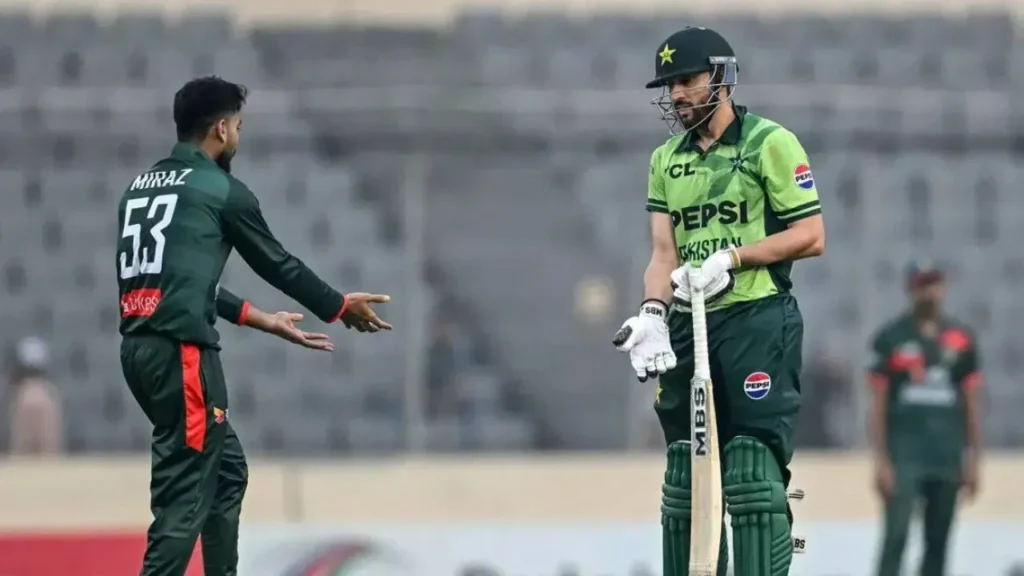
MCC statement on Salman Ali Aga run-out: The Bangladesh vs Pakistan three-match ODI series has ended. The hosts defeated an inexperienced Pakistan team by 11 runs in the final ODI to win the series 2–1. Bangla Tigers completely dominated the first ODI, bowling out the Men in Green for just 114 runs and chasing the target with 8 wickets remaining.
During the second ODI, Pakistan won the match and coincidentally bowled out the home team for the same number of runs, 114 runs, while they were chasing 274 runs. In the second ODI, a controversial incident happened with Salman Ali Aga and Mehdi Hasan Miraj. When Miraj was bowling, Mohammad Rizwan hit the ball at mid-on and while trying to block it, he got into a tussle with non-striker Salman Agha.
ICC reprimanded Salman Ali Aga
The Bangladesh captain stopped the ball, which came to non-striker Salman Ali Aga, who was some distance away from the crease. Agha tried to pick up the ball to stop it and possibly return it to the bowler. However, the rival captain picked up the ball and threw it at the stumps, resulting in a run out.


Salman Ali Agha is angry!
After that scuffle on the field, Salman Ali Aga is seen absolutely angry. #BANvPAK
– Ahmed Says (@Ahm67518) 13 March 2026
On appeal, Agha was declared run out, and the batsman was furious after being given out in an unusual manner. Aga used horrible hand gestures and said something unusual, and was thus reprimanded by the International Cricket Council (ICC) following his actions.
MCC issues statement on controversial run-out
Now Marylebone Cricket Club (MCC), the guardian of the rules of cricket, has given its stand on the run-out incident. The MCC said, “Under the law, there is very little that any umpire could have done differently. When the wicket was broken and the ball was in play, the non-striker was clearly out of his ground. He is out.”
“It is also worth pointing out that the non-striker had left his ground when the ball was in motion and had begun attempting to regain his ground when he collided with Mehdi. Furthermore, no batsman should attempt to pick up the ball without the consent of the fielding side, and if he did so, he would be in danger of obstructing the field.”
crucial moment! Mehdi Hasan Miraz dismissed Salman Agha with a brilliant run out. ✓#bcb #Cricket #bangladesh #Pakistan #ODI pic.twitter.com/N0inKkZVwz
– Bangladesh Cricket (@BCBtigers) 13 March 2026
The MCC added, “In retrospect, he could have used that time better to regain his position. There have been some suggestions that the ball should be considered dead. This is not feasible under the Laws; the ball is not dead when players collide – if it were, it would encourage players to seek collisions when the situation was advantageous.”
The MCC said, “There was no question of serious injury, so there could have been no call of dead ball for him. It could not have been clear to the umpire that all players had ceased to believe the ball was in play, because Mehdi clearly believed it was live, even if Agha did not. And it could not ultimately have been adjudged to be in the hands of the bowler or the wicketkeeper, because it was on the ground.”
New laws introduced by MCC
MCC also discussed the new law coming in October. Only the on-field umpire will decide whether the ball is dead or not.
“Under the new laws, which will come into effect in October, an umpire will be able to determine that the ball has finally settled if it is stationary on the ground. However, it is difficult to argue that the ball has finally settled if the fielder nearest to him is attempting to run out the non-striker while the non-striker is off his ground,” the MCC said.
“Therefore, there is no case made out that this was not under the law, nor can the law be rewritten in any way to create such a situation.”
Also Read: IPL 2026 Injury Update Live: Complete List of Injured Players, Replacements and Latest News