


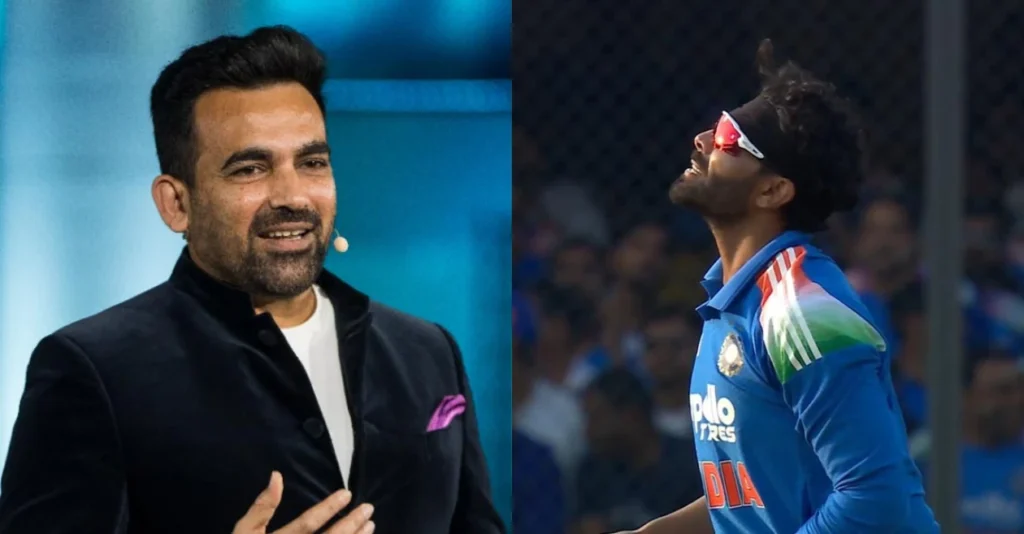


India cricket legends Zaheer Khan and Ajinkya Rahane have questioned Ravindra Jadeja’s effectiveness in the middle overs of One Day Internationals (ODIs) following India’s series-deciding defeat against New Zealand in Indore on Sunday, January 18. The discussion emerged after India lost the third ODI by 41 runs and won the series (2–1) – New Zealand’s first ODI series win on Indian soil.
New Zealand’s batting dominance determines victory in the series decider
New Zealand, who came to bat first at Holkar Cricket Stadium, scored 337 runs for 8 wickets in 50 overs. The foundation of the total was a mammoth 219-run partnership for the fourth wicket between Daryl Mitchell and Glenn Phillips. Mitchell scored a brilliant 137, while Phillips complemented him with 106 and dismantled India’s bowling plans during the middle and death overs.
Arshdeep Singh and Harshit Rana performed well for India by taking three wickets each. However, a lack of control from the rest of the bowling unit allowed New Zealand to maintain the pace throughout the innings.
In reply, India’s chase never really materialized after an early defeat at the top. Virat Kohli once again stood his ground and took the innings forward by scoring a brilliant 124 runs. He got support from Nitish Kumar Reddy (53) and Harshit Rana (52), but partnerships failed to flourish as the required rate kept rising.
India were eventually bowled out for 296, giving New Zealand a famous 41-run win and sealing the historic series win. The defeat prompted post-match analysis, which focused on India’s middle overs bowling and Jadeja’s role in that phase.
Ravindra Jadeja’s ODI performance under scrutiny
Jadeja endured a tough series as he struggled to make an impact with either bat or ball. In three ODIs, the veteran all-rounder scored only 43 runs and failed to take a single wicket, conceding 141 runs in 25 overs.
In the opening ODI in Vadodara, Jadeja gave away 56 runs in nine overs. He then gave away 44 runs in eight overs in Rajkot, followed by 41 runs in six overs in Indore, where he was brought in to bowl only the 30th over. These returns raised concerns about his ability to control and influence the middle overs.
Zaheer Khan: “Containment is no longer enough”
Speaking on Cricbuzz, Zaheer emphasized how the ODI format has evolved, especially during the middle overs. According to him, bowlers can no longer play a completely restrained role.
“The ODI format has changed. You can’t just control the bowling in the middle overs.” Zaheer said. He said teams now see this phase as an opportunity to change momentum, making wicket-taking a key requirement. Zaheer stressed that Jadeja should focus on being more aggressive and effective with the ball in ODIs.
“Everyone looks at that phase as an opportunity to change the pace, so you can’t just be composed; you also have to be aggressive and take wickets. Ravindra Jadeja needs to focus on that aspect of his game in ODIs,” The former India fast bowler added.
Ajinkya Rahane: “Predictable”
Ajinkya Rahane also expressed similar concerns, suggesting that Jadeja’s lack of variety made him easier to line up. Rahane said bowling at a similar pace, especially with only one fielder outside the circle, allows the batsmen to settle down.
He compared Jadeja’s approach to Axar Patel and highlighted how changes in pace, angle and crease usage can disrupt batsmen.
“In ODI matches, you have to have variations. However, Jadeja is a proven performer in all conditions, he bowls at a consistent pace and can be predictable. With only one fielder, if the bowler maintains the same pace then it becomes easier for the batsman. With Axar, he has variations; he changes his pace and uses the angles at the crease very well. So, there is healthy competition, and I am sure Jadeja understands this, because he Know your game well,” Rahane said.
Rahane also underlined the importance of evolving with the conditions, saying that while Jadeja is lethal on turning tracks, flat wickets demand adaptability and new plans.
“Jadeja likes to keep his game simple with the ball. But you have to evolve depending on the conditions. On turning tracks, he is lethal. But on a flat wicket, he has to adjust and formulate different plans, making better use of the angles.” Former Indian Test captain added.