


table of contents


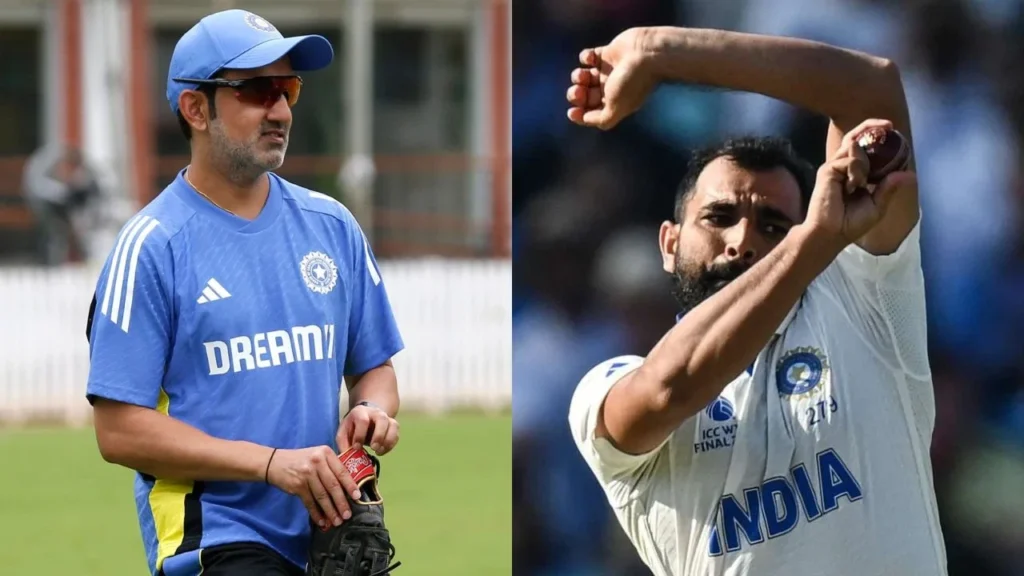
A report by Cricblogger has made a significant claim regarding Mohammed Shami’s continued absence from India’s Test setup, alleging that head coach Gautam Gambhir is opposed to the veteran fast bowler’s return. According to the report, some selectors still see the fast bowler as a valuable red-ball option, but the head coach has reservations about bringing him back into the team.
According to the report, Mohammed Shami himself admits that his prolonged absence from the Indian dressing room is largely due to Gautam Gambhir’s stance on his selection.

What is claimed in the report regarding the absence of Mohammed Shami?
According to Cricblogger, there is difference of opinion in the Indian cricket setup regarding the future of Mohammed Shami. The report claims that while some selectors see the experienced fast bowler as a strong Test option, Gambhir is against his return.
Sources cited in the report alleged that this disagreement played a major role in Mohammed Shami being left out of India’s plans despite his vast experience and proven record in overseas conditions.
The report also claims that Shami personally believes that Gautam Gambhir does not want him in the team.


Why has Mohammed Shami’s future become a topic of discussion?
Shami’s future has been a major topic of discussion as he finds himself at a stage where India’s chances of a comeback do not look very bright. The team is entering a period of change and young fast bowlers are being given increasing opportunities.
The 35-year-old has also had to deal with injury concerns in recent years. Questions related to workload management, fitness and long-term availability have inevitably become part of every discussion regarding his selection.
Chief selector Ajit Agarkar’s recent comments also highlighted the fitness aspect. Earlier this year, Agarkar had said that Mohammed Shami was considered ready for T20 cricket but not yet for the demands of Test cricket, suggesting that physical preparation remains a factor in selection discussions.
That context is important because it provides a cricketing explanation for the claims made in the report, as well as their absence.
The numbers that still support Shami’s case for Test cricket
Despite the uncertainty over his future, Mohammed Shami’s Test record is difficult to ignore.
The experienced seamer has taken 229 wickets in 64 Test matches at an average of 27.71, making him one of India’s most successful fast bowlers of the modern era. He also has the feat of taking five wickets six times in this format.
More importantly, Shami has consistently performed well in overseas conditions. His ability to seam the ball at pace, attack the stumps and create reverse swing has made him a key component of India’s pace revolution in the last decade.
Even when injuries hampered his progress, Shami consistently returned to perform at the highest level. His record in England, South Africa, Australia and New Zealand is one of the strongest among Indian fast bowlers of his generation.
For selectors looking only at experience and proven Test pedigree, there is still a compelling cricket case to include him.
How much influence does Gautam Gambhir really have on selection?
Shami’s report came after the same Cricblogger story which claimed that Gambhir’s opinion was sought before the BCCI finalized Ajit Agarkar’s extension as chairman of selectors.
That report suggested that Gambhir has significant influence in the Indian set-up and plays a key role in discussions regarding team structure and long-term planning.
Even if those claims are accurate, modern cricket selection is rarely the responsibility of any one person. The head coach, captain, selectors, performance analysts and medical staff all contribute to decision making.
The coach’s opinion is naturally important as he is responsible for implementing the team’s strategy and managing the players on a day-to-day basis. However, the official selection authority still lies with the selection committee.
If not Mohammed Shami, who is India’s favorite pace option?
Another important factor is India’s emerging fast bowling landscape. Jasprit Bumrah continues to be the leader of the attack whenever available, while Mohammed Siraj has established himself as a senior figure within the pace unit. Siraj’s performance during India’s recent Test assignments demonstrated his ability to take up big responsibility when required.
Along with them, India has invested rapidly in young fast players like Prasidh Krishna, Harshit Rana, Akash Deep, Gurnoor Brar and other emerging options. The management may view this period as an opportunity to build a pace attack capable of serving the team during the next World Test Championship cycle. In such circumstances, difficult decisions involving senior players become inevitable.
This does not mean that Mohammed Shami has been unfairly overlooked; This may simply reflect the realities of succession planning.