


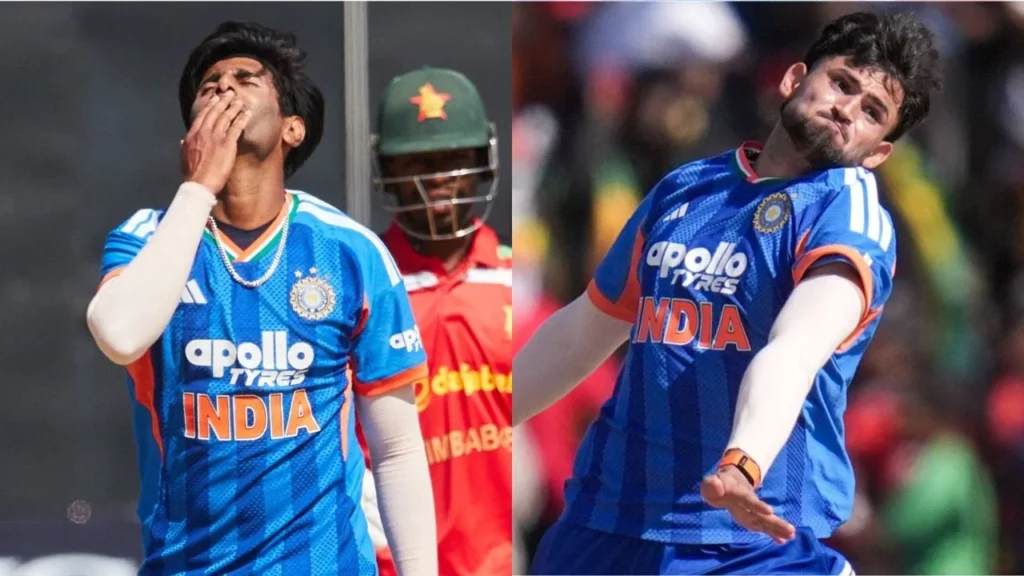
India’s new-ball pair Mayank Yadav and Ashok Sharma created an unusual record during the first T20I against Zimbabwe in Harare.
While the duo impressed with their pace, they also became the first Indian opening bowling pair to share the same date of birth in men’s T20Is.
Mayank Yadav, Ashok Sharma were born on the same day, created India’s unique T20I record
The opening T20 match between India and Zimbabwe was memorable in more ways than just the result. India’s pace attack opened the innings with Mayank Yadav and debutant Ashok Sharma, born on 17 June 2002.
In international cricket, it is a rare occurrence for both the opening bowlers of a team to have the same birthday. According to Cricinfo, Mayank Yadav and Ashok Sharma have become the first Indian pair to achieve this feat in men’s international cricket.
Only two other known pairs have made their bowling debut after being born on the same date:
- Timezine Rapi and Matthew Fatea (Samoa vs Fiji, 2023) – both born 30 August 2003
- Edward Taylor and Guillermo Aburto (Chile vs. Mexico, 2023) – both born February 29, 1984
Mayank Yadav and Ashok Sharma, who opened the bowling for India in the first T20I against Zimbabwe, were born on the same day – 17 June 2002.
Other pairs born on the same date to open the bowling in an innings in men’s international cricket (where data is available):
Timezine… pic.twitter.com/FldZ4zQXKl– Cricinfo (@cricinfo) July 24, 2026
This coincidence added another layer to an already special evening for the two young fast bowlers. While Mayank was making a comeback to international cricket after a long injury, Ashok was fulfilling his dream by making his debut for India. Together, they provided India with excellent starts and showcased the country’s growing fast bowling depth.
How did Mayank Yadav and Ashok Sharma perform in the first T20 match against Zimbabwe?
Mayank Yadav wasted no time in making an impact. Bowling the very first ball of the match, the Express pacer dismissed Brian Bennett for a golden duck after India successfully reviewed the on-field decision. With this, he became the third Indian bowler to take a wicket on the opening ball of men’s T20I.
Working consistently in the mid to high 140 kmph range, Mayank troubled the Zimbabwean batsmen in his opening spells. He repeatedly beat Dion Myers with balls that veered away before dismissing him for six with a sharp back-of-a-length ball. Their early bursts reduced Zimbabwe to 21/3, leaving India firmly in control.
Although Tadivanashe Marumani hit some final boundaries in the final overs, Mayank finished with excellent figures of 2/18, conceding only 4.50 runs in four overs. He bowled 17 dot balls and was named player of the match for his match-defining spell.
Meanwhile, Ashok Sharma had a quiet but encouraging international debut. The Rajasthan pacer consistently touched the mid-140 kmph mark while troubling Ben Curran and Ryan Burl with his blistering pace and disciplined length. While he did not get any wickets, he bowled several testing balls that hit the bat and kept Zimbabwe’s scoring in check in the middle overs.
Ashok finished his first spell for India with figures of 0/29 from four overs. Wickets may not have come from him, but his pace, control and composure suggest he has the tools to become a regular feature in India’s fast bowling setup.
India won the first match under the leadership of captain Shreyas Iyer.
India recorded an impressive seven-wicket win to take a 1-0 lead in the three-match series and give Shreyas Iyer his first win as India’s T20I captain. The result also ended India’s seven-match winless deficit in this format and broke Iyer’s own streak of winning seven consecutive toss as captain.
After restricting Zimbabwe to 125/7, largely thanks to Mayank Yadav’s flamboyant opening spell and two wickets each from Mayank and Prince Yadav, India’s chase was capped by Vaibhav Suryavanshi. Kishore played a breathtaking inning of 50 runs in just 19 balls, achieving the historic feat in just 18 balls, while Ishan Kishan scored 35 runs in 24 balls.
Captain Shreyas Iyer remained unbeaten on 28 as India reached 126/3 in just 13.2 overs with 40 balls remaining. This vigorous chase became India’s fourth fastest successful chase of over 120 targets in men’s T20Is in terms of balls remaining.