


table of contents


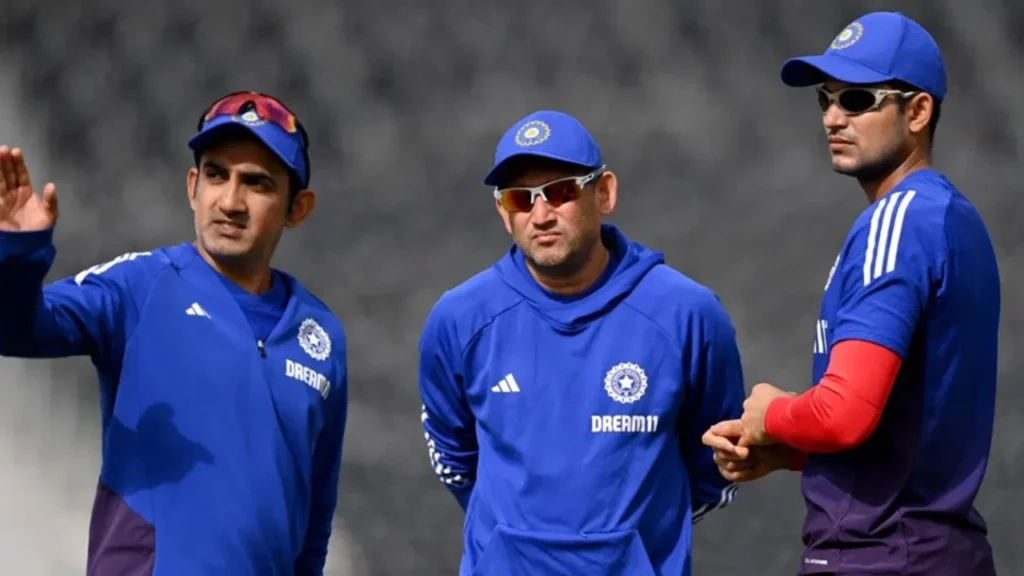
A report in Cricblogger claims that India head coach Gautam Gambhir’s approval was sought before the BCCI finalized chief selector Ajit Agarkar’s extension.
It has been suggested that the decision was delayed for some time as the board waited for Gambhir’s opinion before taking the final decision.

The report further states that Gautam Gambhir has emerged as one of the most influential figures in Indian cricket with significant inputs on team-related matters.
What is claimed in the report regarding Ajit Agarkar’s extension?
According to the report, Agarkar’s extension as chairman of selectors was not finalized immediately as the BCCI wanted clarity on Gautam Gambhir’s status before moving forward.
The report quoted a source as saying that the India head coach has a “major say on most matters” related to the national team setup. It has been suggested that Gambhir’s views are given considerable importance in discussions related to team planning and team management.


It also claimed that he had the ability to strongly advocate for certain players and influence selection negotiations. Importantly, these claims were attributed to unnamed sources, and there has been no official confirmation regarding the alleged decision-making process behind Ajit Agarkar’s extension.
The report said, “Such levels of influence are virtually unheard of in Indian cricket. According to sources, Gambhir enjoys immense authority over team matters. He can favor players for selection, exert pressure for exclusions and have significant influence over the team structure.”
Why might Gautam Gambhir’s opinion matter in the selection discussion?
Even without taking the report’s claims as fact, it is easy to understand why a head coach’s opinion would be considered important in modern international cricket.
The coach is responsible for implementing long-term plans, developing playing combinations, managing the workload of players, and preparing teams for major tournaments.
As a result, coordination between the coaching staff and the selection committee has become increasingly important in cricket playing nations. A selector may identify the best available talent pool, but the coach ultimately works with those players on a daily basis.
Therefore, discussions between coaches and selectors are now a normal part of team-building at the highest level. If the chief selector and the head coach share a similar approach, it becomes easier to maintain continuity across all formats and tournament cycles.
That is why counseling between the two conditions is generally seen as beneficial rather than abnormal. However, mentoring is different from controlling, and the exact extent of any coach’s influence often remains behind closed doors.
A decision where Gautam Gambhir did not get his desired result
Interestingly, the same report claims that Gambhir’s impact is not complete. According to Cricblogger, Gambhir was not in favor of making Shreyas Iyer India’s T20I captain and would have preferred either Sanju Samson or Ishan Kishan for the role.
The report alleged that the BCCI made it clear that the appointment of the captain is the responsibility of the selectors rather than the coach. As a result, Shreyas Iyer was reportedly appointed despite not being Gautam Gambhir’s preferred choice.
It was claimed that the selectors wanted Shreyas Iyer in India’s T20 World Cup squad, while Gautam Gambhir had favored Washington Sundar for selection.
How India’s previous head coaches worked with selectors
The relationship between India’s head coach and the selection committee has evolved significantly over the years. During Ravi Shastri’s tenure, his close working relationship with then captain Virat Kohli often attracted public attention.
While Shastri was widely regarded as an influential voice within the setup, the selectors retained formal authority over team selection. Public discussion often focused on the Kohli-Shastri leadership combination, but major decisions were still officially made through the selection committee.
Under Rahul Dravid, the structure appeared more collaborative and less public. Dravid rarely commented on selection matters other than explaining team requirements and combinations. His tenure was characterized by a generally cool working relationship between the coaching staff and selectors.
Going further back, coaches traditionally had even less influence on selection matters. The Indian system has historically placed considerable authority in the hands of the selectors, while coaches focus primarily on preparation and performance.
“International cricket has changed dramatically. Multi-format scheduling, workload management, data analysis and long-term planning have increased the importance of the coaching staff in strategic decision making.
As a result, modern coaches often play a larger advisory role than their predecessors. The main difference is that such impacts are rarely discussed publicly, making reports like this particularly notable. Meanwhile, Ravichandran Ashwin recently criticized Gautam Gambhir after ignoring Sanju Samson.