
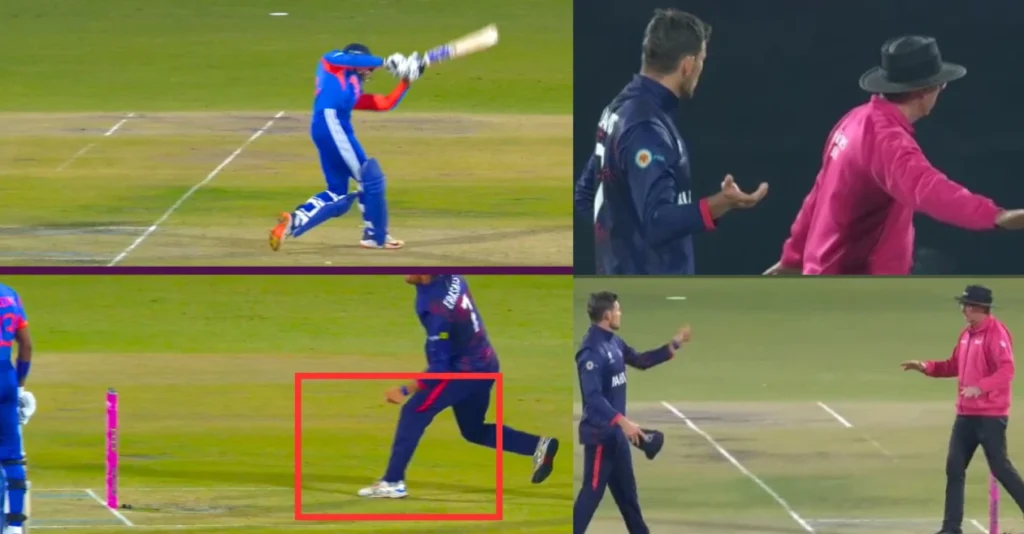

ICC Men’s T20 World Cup 2026 Clashes were witnessed during the clash between Group A India And namibia Namibian captain at the Arun Jaitley Stadium on Thursday, 12 February gerhard erasmus Looked very disappointed after the umpire rod tucker One of his balls was called a dead ball, forcing him to bowl again.
After winning the toss and electing to bowl, Erasmus took India to 100 in just seven overs. The captain started to pull things back when he introduced himself in the eighth over. But drama unfolded on the fifth ball of the over when Tucker intervened and declared the delivery dead – to the disbelief of Erasmus.
Gerhard Erasmus’ bowling status at the center of controversy
The controversy arose from the round-arm sling action of the Erasmus and its position at the time of delivery. As part of his run-up, the 30-year-old released the ball from well behind the crease, a technique that caught Tucker’s attention.
The umpire objected to the manner of the delivery, leading to a heated exchange between the Namibian captain and the match official. While Erasmus argued his case, Tucker stood firm on his interpretation of the situation.
controversy 🚨
Gerhard Erasmus bowled it past the umpire but umpire Rod Tucker declared it a dead ball.
He’s done this before and never got called out
What is your opinion on this?? #Cricket #T20WorldCup2026 #INDvNAM pic.twitter.com/A3SGxgJzHw
– Sports Cricket (@Khelnowcricket) 12 February 2026
Interestingly, the decision inadvertently went in favor of Namibia. The initial delivery was signaled wide, but with a call for “dead ball”, India did not get the extra run.
What was that spinning delivery from Namibia captain Gerhard Erasmus?
He bowled from such a distance from the crease and dismissed Tilak Verma.
He had bowled like this before and the umpire had declared it a dead ball – so why not this time? 🤔 pic.twitter.com/IwaOS7Gppg
– Mention Cricket (@MentionCricket) 12 February 2026
Umpire discretion and MCC laws add complexity
The legality of bowling from behind the crease is not explicitly prohibited under the traditional guidelines of cricket, provided the bowler remains within the field of play and bowls within the umpire’s line of sight. Erasmus has previously adopted this view without any objection.
However, under the MCC Rules of Cricket – specifically Law 20.4.2 relating to the dead ball and Law 41.2 addressing unfair play – umpires have discretionary powers to intervene if they feel the delivery is an unfair action or deliberately distracts the batsman. The wording of these provisions leaves room for interpretation, meaning that Tucker’s decision, while controversial, was not necessarily wrong within the framework of the laws.
Following discussions, Tucker allowed Erasmus to continue bowling with a similar approach in the subsequent spell, suggesting that a mutual understanding had been reached.
Erasmus responded with the best bowling figures in T20 Internationals
If the decision unsettled Erasmus, it had no effect on his performance. The Namibian captain produced one of the best spells by any captain in the history of the T20 World Cup, taking 4 for 20 in his four overs.
Their leading batsmen included Suryakumar Yadav, Tilak Verma, Hardik Pandya and Axar Patel. This spell recorded the joint-second best bowling figures by a captain in a T20 World Cup match.
As far as the result of the match is concerned. India restricted Namibia to 116 Chasing the target of 210 runs, they won the match by 92 runs in 18.2 overs.
