


table of contents

At the end of each IPL season, the league honors players who have performed exceptionally well in every category by presenting mementos. The Orange Cap is given to the player who scores the most runs in the season, the Purple Cap is given to the player who takes the most wickets, and the MVP award is given to the player who outperforms the rest in one or both departments.
The Most Valuable Player award is given to the player with the most MVP points in the IPL’s official ranking system. The award was originally established in 2013, before which it was known as the Man of the Tournament award.

The current system, at least according to this points system, sets an objective criterion in determining the best player of the IPL season. The previous award was given mostly on a subjective basis.
In this article, we’ll revisit every winner of the award from 2008 to 2026.
Every IPL MVP Award Winner
2008: Shane Watson (RR)
In IPL 2008, Watson was easily the most important player for Rajasthan Royals, who won the first edition of the IPL. With 472 runs at an average of 47 and a strike rate of 152, Watson was the team’s leading run-scorer and the fourth-highest run-scorer in the entire tournament.


He also took 17 wickets at an average of 22.5 and an economy rate of 7. Watson’s double of 400 runs and 15 wickets in a single IPL season has been repeated only twice since then.
2009: Adam Gilchrist (DCH)
Gilchrist was captain when Deccan Chargers went on to win the tournament in 2009 after finishing last in 2008.
He scored 495 runs in that tournament and finished second in the Orange Cap table. He scored just 3 half-centuries, but had a batting average of 31 and a strike rate of 152. And that year no player hit more than his 29 sixes. His 18 dismissals as a wicketkeeper were also an unmatched figure.
2010: Sachin Tendulkar (MI)
Even at the age of 37, Sachin Tendulkar showed that he has what it takes to play T20 cricket. Even though MI finished runners-up, Tendulkar won the Orange Cap with 618 runs at an average of 47.5. This made him the first Indian player to win the Orange Cap at the end of the IPL season.
2011: Chris Gayle (RCB)
Although CSK defended their IPL title in 2011, in terms of individual achievements, the next three IPL seasons would entirely belong to Chris Gayle. In 2011, he joined RCB as an injury replacement but walked away with the Orange Cap. Gayle scored 608 runs in just 12 matches at a batting average of 68 and strike rate of 183.
His 44 sixes also remained unbeaten. In his very first match for RCB, Gayle scored a century against his former franchise KKR and added another century against KXIP. He became the first player to score more than one century in an IPL season.
2012: Sunil Narine (KKR)
This season was Narine’s first of three MVP awards in IPL history. In 2012, Sunil Narine was a relatively unknown and inexperienced commodity.
In 2012, he laid a trap for everyone when KKR won their first IPL title. With 24 wickets in 15 matches, he finished second in the Purple Cap list. His bowling average was only 13.50 and economy rate was 5.48. He also took five wickets against KXIP.
2013: Shane Watson (RR)
In 2013, Watson became the first player to win the MVP award twice. 2013 was also the year the IPL introduced an official MVP point team. In this system, every six hits and every wicket gets 3.5 points. Each four hits, each catch taken, and each stumping is worth 2.5 points. And each dot ball thrown scores one point.
Watson won the 2013 award with 386 MVP points. He scored 543 runs at an average of 39 and strike rate of 143. He also scored a century against CSK. His 13 wickets that year came at an average of 22.92 and an economy of 7.95. RR finished third that year as they lost Qualifier 2.
2014: Glenn Maxwell (KXIP)
2014 was the year the IPL was introduced to Glenn Maxwell’s “Big Show”. Maxwell was essentially the middle-order revolution that took Kings XI Punjab to the runner-up finish.
Maxwell scored 552 runs at an average of 34.5 and strike rate of 188. His 36 sixes were also the highest in the season. Glenn Maxwell finished IPL 2014 with 286 MVP points.
2015: Andre Russell (KKR)
Despite KKR finishing 5th out of 8 teams, Jamaica had done enough to win on the MVP points system. In 2015, he scored 326 runs at an average of 36.22 and strike rate of 193. That year he also scored three half-centuries.
With the ball, he took 13 wickets at a bowling average of 23 and an economy rate of less than 8. Andre Russell finished IPL 2015 with 312 MVP points.
2016: Virat Kohli (RCB)
Like some of the other names mentioned here, RCB did not win the IPL in 2016 and unfortunately finished as runners-up. But Virat Kohli’s brilliant performance with the bat has ruled the discussion even after a decade.
973 runs at an average of 81 and strike rate of 152 with 4 centuries, 7 half-centuries and 38 sixes. Kohli finished that tournament with the Orange Cap and the most number of sixes. Since then no other batsman has ever scored 900 runs in an IPL season, and only one batsman has ever scored 4 centuries in a season again. Kohli finished with 356.5 MVP points that year.
2017: Ben Stokes (RPS)
At the IPL auction that year, Stokes was the most expensive buy when Rising Pune Supergiant paid Rs 14.5 crore for him. Stokes repaid that faith by making an important contribution in taking the team to the runner-up finish.
Batting at number 5, Stokes scored 316 runs at an average of 31.6, a strike rate of 143 and one century. He also took 12 wickets at an average of 26.33 and an economy rate of 7.18. His MVP point total that season was 279.
2018: Sunil Narine (KKR)
By 2018, Sunil Narine started performing tremendously not only with the ball but also with the bat. Opening as a pinch hitter, Narine did his job well. That year he scored 357 runs at a strike rate of 190 and an average of 22. He also scored two half-centuries.
With the ball, he remained the Sunil Narine everyone knew. He took 17 wickets at an economy rate of 7.67 and a bowling average of 27.5. Narine finished that season with 379.5 MVP points. KKR finished third in IPL 2018 after losing to SRH in Qualifier 2.
2019: Andre Russell (KKR)
Like four years ago, Russell won the MVP award despite KKR failing to reach the playoffs. KKR fell behind in the end, but Russell had a brilliant performance with the bat. Russell scored 510 runs at a batting average of 57 and a strike rate of 205.
As of 2026, this was the only instance of a batsman scoring 500 runs at a strike rate of over 200 in an IPL season. There were also 52 sixes and 11 wickets in it. Russell’s MVP point total was 369.
2020: Jofra Archer (RR)
While both of Russell’s MVP awards came when his team missed the playoffs by a narrow margin, Jofra Archer’s award in 2020 came when his team finished last in the points table.
Archer took 20 wickets at an average of 18.25 and an economy rate of 6.5. He also occasionally served as a pinch-hitter. Archer’s MVP point total for IPL 2020 was 307 points.
2021: Harshal Patel (RCB)
Harshal Patel’s exploits in IPL 2021 earned him the nickname “Purple Patel”. The 2021 season was divided between India and UAE.
That year, Harshal equaled Dwayne Bravo’s record of taking most wickets in a single season of IPL by taking 32 wickets. Same numbers as Bravo’s 2013 season. But Bravo had 18 matches that year compared to Harshal’s 15 in 2021. Patel’s bowling average was 14.34 and MVP points total of 264.5.
2022: Jos Buttler (RR)
RR finished runners-up in 2022 as they played their first IPL final since 2008. Jos Buttler was the main man behind reaching the final that year as he won the Orange Cap.
Buttler became the second player to score 4 centuries in an IPL season in 2022. He scored 863 runs at an average of 57 and a strike rate of 149 with 45 sixes. Butler scored 387 MVP points, and his scoring total was the second highest in a season until the following year.
2023: Shubman Gill (GT)
Gill overtook Buttler’s 2022 season as he scored 890 runs and fell just shy of becoming only the second player to score 900 runs in an IPL season.
Gill averaged 59 and strike rate 158 as he scored 3 centuries and won the Orange Cap, although GT finished runners-up. Gill’s MVP point total was 343.
2024: Sunil Narine (KKR)
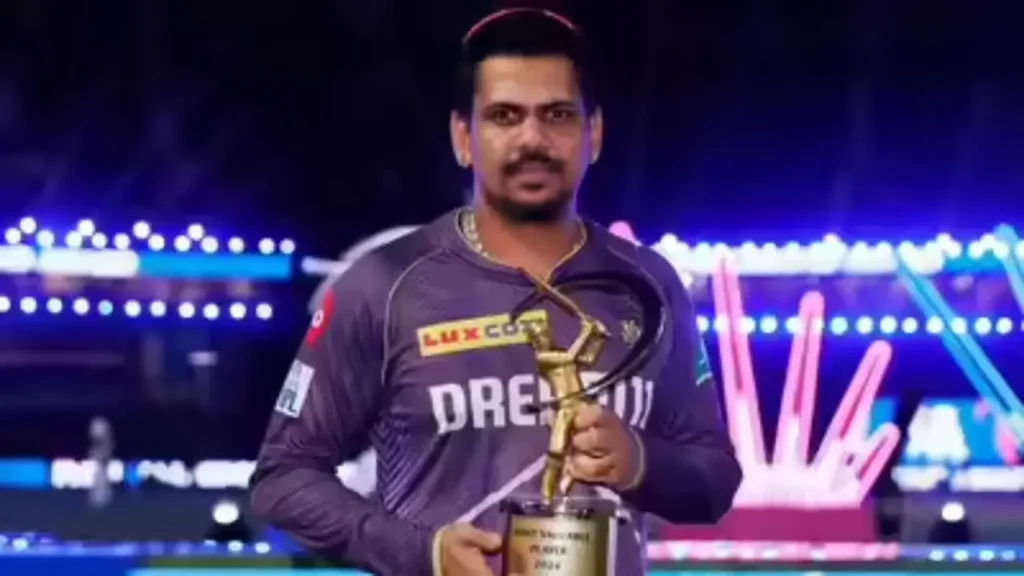
Sunil Narine’s third of three IPL MVP awards. It was the first time that a player from an IPL trophy-winning team had won the MVP award since the award was first won in 2012. Narine once again regained his lost identity with the bat. He became the leading run-scorer and joint fourth-highest wicket-taker for KKR, ending KKR’s 10-year title drought.
Narine’s 488 runs, including a century, came at an average of 35 and a strike rate of 181. His 17 wickets came at an average of 21.65 runs and 6.69 runs per over. In IPL 2024, Narine finished with 450 MVP points, which is easily a record total.
2025: Suryakumar Yadav (MI)
In IPL 2025, Suryakumar Yadav was at the center of Mumbai Indians’ comeback to the third position. MI had won only 1 of their first 5 matches, but won 7 of their last 9 matches to reach the playoffs. MI then defeated GT in the Eliminator but lost to PBKS in Qualifier 2.
Surya broke the record for most runs by an MI batsman in a single IPL season by scoring 717 runs at an average of 65 and strike rate of 168. He also broke a world record by scoring more than 25 runs in each of the 16 innings played. His MVP points total was 320.5.
Also Read: IPL Final Hero: Complete list of Player of the Match award winners in every IPL final