


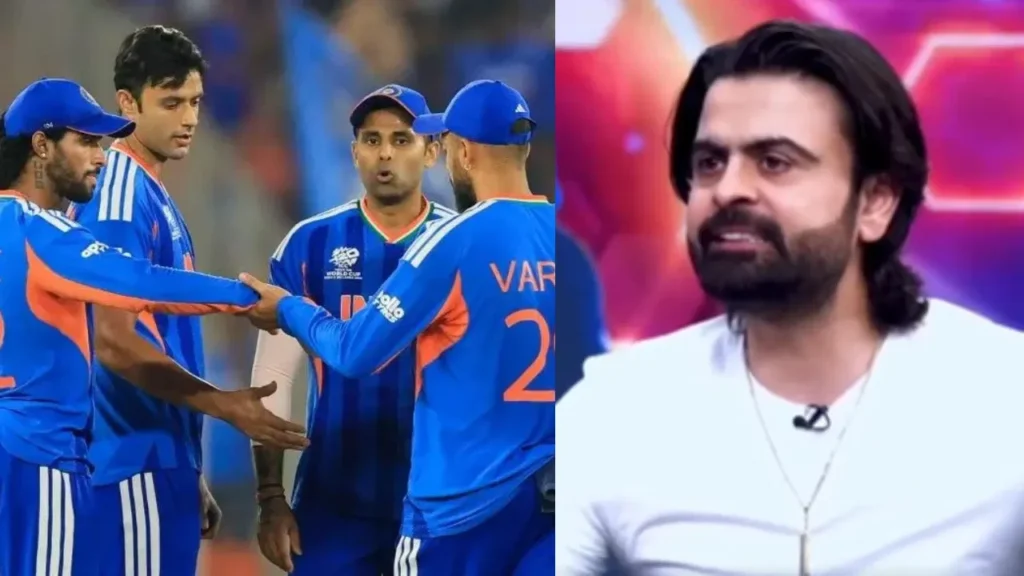
Just before the second semi-final of the ongoing T20 World Cup 2026 between India and England in Mumbai on March 5, a fresh controversy has arisen in the cricket world. Former Pakistan opener Ahmed Shehzad has made a shocking claim involving India’s anti-doping system in global events.
The timing of Shehzad’s claim has made the situation even more dramatic as it came just ahead of the India vs England semi-final at the iconic Wankhede Stadium in Mumbai.
Ahmed Shehzad makes big claim on India’s dope testing before T20 World Cup 2026 semi-finals
During a discussion in a Pakistani television show, Ahmed Shehzad made serious allegations against the Board of Control for Cricket in India (BCCI). He claimed that the BCCI does not allow the International Cricket Council (ICC) to directly conduct dope tests on Indian cricketers during global events.


Also read: Ahmed Shehzad exposes ‘evil’ Misbah-ul-Haq for withholding Babar Azam’s teammate’s salary
Ahmed Shehzad further claimed that whenever the ICC wants to test Indian players during international tournaments, the BCCI prefers to handle the testing itself citing its best convenience rather than letting ICC officials complete the process.
Ahmed Shahzad said in Geo TV’s show Harna Mana Hai, “BCCI does not allow ICC to do dope test of Indian players during ICC events. Dope test is used to check whether players are taking drugs or banned substances. Whenever ICC asks to do dope test of Indian players, BCCI rejects it and says that they have better technology to test their players themselves.”
BCCI does not allow ICC to do dope test of Indian players
Ahmed Shehzad – BCCI does not allow ICC to conduct dope tests on Indian players during ICC events, dope tests are used to check whether players are taking drugs or banned substances.
– whenever… pic.twitter.com/h9szYKhe0l
– Bemba Tavuma (@gaandfaadtits) 5 March 2026
His claim has raised many questions as anti-doping testing in international cricket has to follow the rules set by the World Anti-Doping Agency (WADA). Under this system, the ICC is responsible for implementing testing procedures during international matches.
How does the ICC Anti-Doping System work?
These anti-doping tests are designed to ensure that players are not using banned substances or drugs to gain an unfair advantage. This procedure usually involves taking urine and blood samples. Players may be tested randomly or based on specific suspicions.
Testing can take place during the match, after the match or even outside the competition when teams are training or travelling. This system is in place to protect the fairness and integrity of the game.
Also read: Gautam Gambhir left Team India camp before T20 World Cup 2026 semi-finals for this big reason
If a player is found guilty of consuming banned substances or violating anti-doping rules, the ICC reserves the right to take strict action. This may include suspension, ban from international cricket and other disciplinary penalties, depending on the severity of the violation.
However, the claims made by Ahmed Shehzad have not been confirmed by any official body yet. Neither the ICC nor the BCCI have yet responded publicly to his allegations.
Mohammad Amir predicts England vs New Zealand final
During the same discussion, former Pakistan fast bowler Mohammad Amir, citing India’s struggling batting unit, has predicted that England will face New Zealand in the final of the T20 World Cup 2026 on March 8.
Aamir said during a discussion on the same show, “But if you talk about India, only one or two of their batsmen are performing. Those batsmen often perform well, but only one or two are able to perform. If you look at their overall batting, they are not in form. You cannot be sure that this team will dominate. I think England will be the favourites.”