


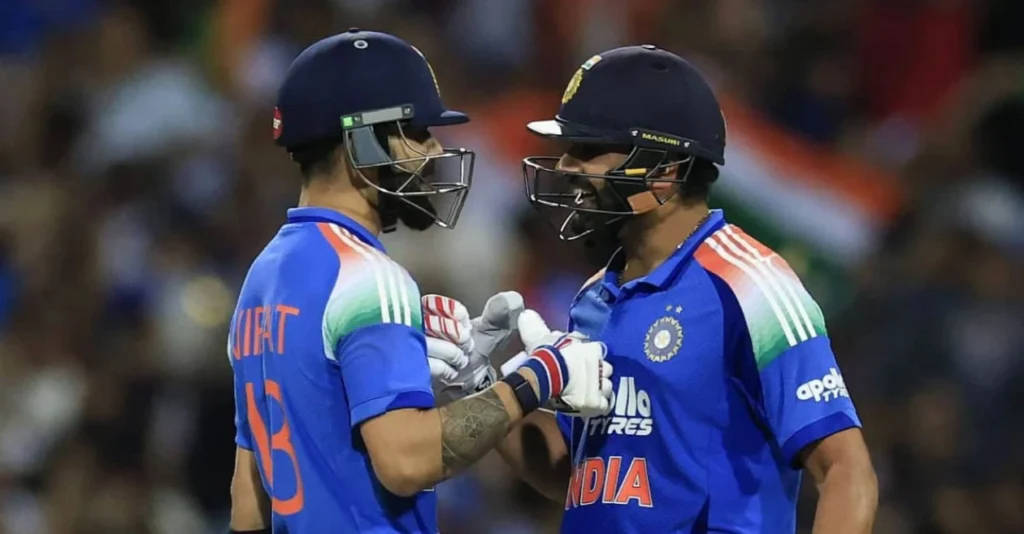


Former Indian opening batsman Aakash Chopra has sparked a new debate in cricket circles by naming its top five Indian batsmen against white-ball spin – without including two of India’s biggest icons. at a time when ipl 2026 The spinners have seen dominance in the middle overs, with their selection reflecting a change in the way modern T20 batting is evaluated.
Aakash Chopra’s pick: New-age approach to playing spin
Rather than relying solely on reputation or legacy, Chopra’s picks focus on players who consistently attack spin and maintain a high scoring rate. Their list, drawn from recent performances and strategic discussions, includes a mix of youth and experience.
Shreyas Iyer Stands as a prominent figure in this group. Chopra has often described him as one of India’s most reliable middle-order batsmen against spin, particularly praising his ability to dominate without taking unnecessary risks. His ease against both off-spin and leg-spin has made him an exceptional performer in the middle overs.
Shubman GillWho is currently leading Gujarat Titans in IPL 2026 also features prominently. Gill’s calm approach, coupled with his strong technique, allows him to handle spin with ease. His ability to play on the backfoot and rotate the strike efficiently makes him an asset in all formats of the modern day.
then there is sanju samsonWhose talent and innovation make them different. Known for his wide range – both conventional and reverse – Samson has developed into a batsman who can trouble even the best of spinners.
Rishabh Pant Brings a different dimension altogether. Fearless and unpredictable, Pant’s aggressive intent often disrupts the bowler’s rhythm. Even after his comeback, he remains one of the most dangerous players of spin in world cricket.
to complete the list Suryakumar YadavWidely regarded as the ultimate 360-degree batsman. No matter what the match situation, his ability to find gaps and play unorthodox shots makes him a nightmare for spinners.
Neither Virat Kohli nor Rohit Sharma is in Chopra’s top 5.
However, the biggest talking point has been its absence Virat Kohli And Rohit Sharma – Two players who have defined Indian batting for over a decade. His exclusion has drawn sharp reactions on social media and among cricket experts.
For many fans, Kohli’s ouster seems particularly surprising. His record against spin in the longer formats and ODIs has been exceptional, based on accuracy, fitness and consistency. However, in T20 cricket, especially in recent years, his approach against spin has leaned more towards consistency than aggression. In a format where the strike rate often exceeds the accumulation, this subtle change has become a point of discussion.
Rohit’s case is a little different. Although he remains one of the most prolific stroke-makers in the game, there have also been phases – particularly against quality left-arm spin – where he has struggled to establish dominance early in the innings. In the fast-paced environment of IPL T20, where teams are constantly looking to attack the spinners, such weaknesses are magnified.
So, Chopra’s decision seems less about questioning his greatness and more about highlighting the changing demands of T20 cricket. Still, for many, excluding the two modern legends entirely seems like a bold move – perhaps even a controversial stance.
Also read: Who is Kashmira Pardeshi? Meet the viral fan girl of Punjab Kings of IPL 2026
Statistics, strategy and evolution of T20 batting
What distinguishes Chopra’s analysis is its strong reliance on numbers and the context of the match. Their selection is largely based on metrics such as strike rate against spin, boundary percentage and effectiveness during the middle overs – arguably the most important phase in T20 cricket today.
Over the past 18 months, teams in the IPL have increasingly used spin as a control weapon. Franchises like Rajasthan Royals and Lucknow Super Giants have shown how impactful spinners can be when used strategically. As a result, batsmen who can not only survive but dominate spin have become invaluable.
Chopra believes that the new generation players have adapted to these demands better. Instead of playing spin carefully, they try to disrupt the bowler’s rhythm through innovative shot-making and calculated aggression. This fearless approach suits perfectly with the dynamic nature of T20 cricket, where momentum can change in just a few balls.
Reaction to his list has been mixed. Some fans agree that the modern game needs a new lens, one that prioritizes current form and influence over legacy. Others argue that experience and adaptability – qualities embodied by players like Kohli and Rohit – should not be overlooked.
Also read: Yuvraj Singh reveals Stuart Broad’s amazing act with his signed India jersey