
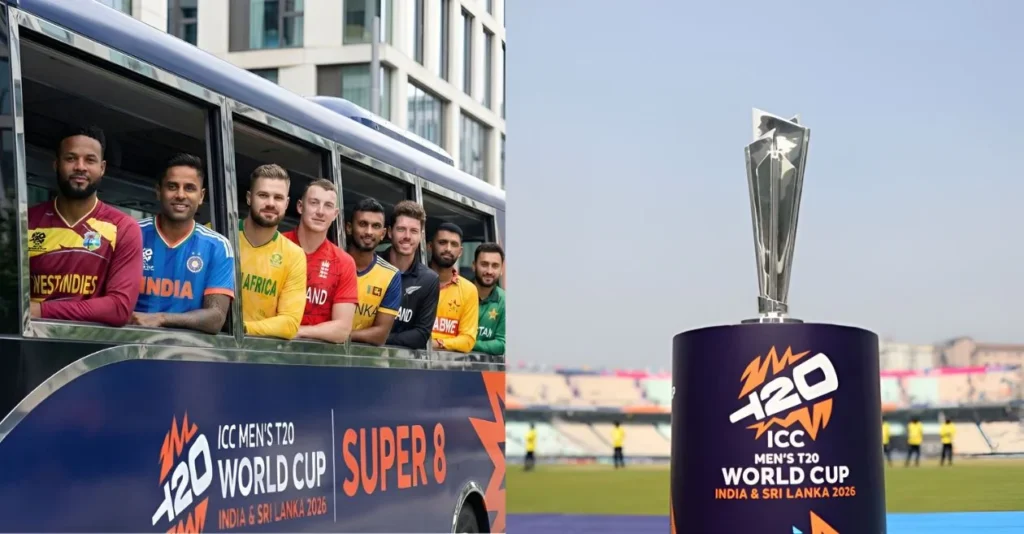

t20 world cup 2026 It was considered the best festival of cricket. Co-hosted by two dynamic nations, full of passionate atmosphere and genuine chaos, the group stage delivered everything fans could have asked for. Then came the Super 8 draw and the celebration turned into controversy.
All four teams won their groups India, Zimbabwe, West Indies And South Africa Has been put in the same Super 8 bracket. Meanwhile the teams that actually lost matches in the group stage are sitting in a comparatively comfortable second tier. Fans are angry, former players are shocked and the ICC is on the defensive. To understand how this happened, one needs to understand a decision taken by the ICC before a single ball was bowled.
How the ICC T20 World Cup 2026 pre-seeding format creates a Super 8 group with all the group winners
Before the tournament began, the ICC assigned fixed seeds to the top eight teams in the world based on their historical rankings. It’s like India was shut down A1. as England C1. as australia B1. as new zealand D1. These designations were permanent, meaning that no matter how these teams performed in the group stage, their Super 8 berth was already decided.
This idea was practically realized on paper. If India’s Super 8 status is decided in advance, broadcasters can sell prime-time advertising slots months in advance. Fans can book flights and hotels without gambling on whether their team will qualify or in which city they will play. Sponsors get certainty. Venues get time to prepare. The entire commercial machinery of the modern World Cup runs more smoothly.
The problem came when Australia got seeded earlier due to B1 group stage exit Completely. Under this system, whoever replaced him simply inherited Australia’s place. that team was zimbabwe. And suddenly a team that had never reached a Super 8 in its history was dropped into a bracket position made up of one of the top teams in the world, sitting alongside India, West Indies And South Africa.
Pre-seed teams and Super 8 slots
| pre-seed | Team | super 8 slots |
|---|---|---|
| A1 | India | locked as x1 |
| B1 | Australia | Replaced by Zimbabwe as X2 |
| C1 | England | Locked as Y1 |
| D1 | new zealand | Locked as Y2 |
Fans’ argument: Why did winning your T20 World Cup 2026 group become a punishment?
This is where the system really broke down. In any fair tournament structure, finishing first in a group brings rewards, an easier path, a better draw and some recognition of better performance. In the T20 World Cup 2026, this has earned teams a nightmare.
Because the pre-seeding slots were decided around historical rankings rather than actual group stage results, the four teams that actually topped their groups all finished on the same side of the bracket. India, Zimbabwe, West Indies And South AfricaAll the invincibles, all deserving of recognition, are now forced to eliminate each other before the semi-finals even begin.
South Africa won every match it played. West Indies dominated from beginning to end. Yet because New Zealand and England were seeded in the second tier before the tournament began, these actual group winners are being considered a tough draw. Two of these four undefeated teams will return home before the Final Four, not because they weren’t good enough, but because a spreadsheet had already decided their fate.
This is the worst way to decide Super 8 seeding before the tournament, I mean let the results of the games decide the group and if Pakistan had problems coming to India then welcome defeat in the group stage.
ICC needs to take cricket seriously, this should not be the way forward!!
– Rajeev (@Rajeev1841) 19 February 2026
ICC is a sham. What does the pool stage mean if the Super 8s are predetermined by seedings? All four countries that finished first in their pools are now in the same Super 8 group.
– Josh Viljoen (@thejoshvlijoen) 19 February 2026
All the fun of the unpredictability of who will face whom in the Super 8 comes from the preferences being decided in advance.
– Udit (@udit_buch) 11 February 2026
Not a fan of pre-seeding of teams by ICC.
It is almost clear which 2 teams are qualifying for the Super-8 stage.
-Aditya Saha (@Adityakrsaha) 11 February 2026
So thank you for the complete and utter incompetence of that organization. @ICC Now we will have all four group winners in one Super 8 group. Whoever decided that “pre-seeding” was a good idea should be sentenced to life in prison.
One of the stupidest decisions in a cricket tournament…
– Dale (@ncakos316) 19 February 2026
- Impropriety: South Africa and West Indies finished first in their groups, but were seeded below England and New Zealand, who lost both matches.
- cost competitive: Teams in the first round had no real incentive to win their group as finishing second actually makes the path to the Super 8 easier.
- Dead rubber problem: Many final group stage matches lost their edge completely once teams realized that finishing on top of the group could work against them.
Group 1 – Powerhouse Bracket
| Team | group stage finale | record |
|---|---|---|
| India | first in group a | invincible |
| zimbabwe | first in group b | invincible |
| west indies | first in group c | invincible |
| South Africa | first in group d | invincible |
How second-placed teams got an easy path to the semi-finals of T20 World Cup 2026
While Group 1 resembles a war zone, Group 2 tells a completely different story. Pakistan, Sri Lanka, England And new zealandEach of them has been given a second-place finisher, what many are calling a gift-filled path to the semi-finals.
Pakistan lost one match in the group stage. Sri Lanka also did it. England and New Zealand, despite their pre-seeded positions, were far from assured. Yet all four find themselves grouped together in a bracket that is statistically much less dangerous than a bracket with four undefeated sides. A team from Group 2 has a much better chance of reaching the last four than any team from Group 1, given where the ICC placed them before the tournament started.
- Group 2 Makeup: Pakistan (A2), Sri Lanka (B2), England (C1 Pre-Seed), New Zealand (D1 Pre-Seed)
- Route problem: The second-place players face an easier path to the semi-finals than the first-place players.
- Incentive loss: The whole purpose of competing for first place in the group stage has become meaningless
Sri Lanka will not be able to play even a single semi-final of T20 World Cup 2026 at home.
Probably the strangest accident of this whole system. Sri Lanka itself, one of the two host countries. A co-host would expect some guarantee of playing his biggest matches on home soil. In 1996 and 2011, the co-hosts were given exactly the same assurance. Not in 2026.
The pre-determined bracket structure means that if Sri Lanka reaches the semi-finals, they will have to travel to India to play their matches. Also, a separate pre-existing agreement guarantees that if Pakistan reaches the semi-finals, the Colombo venue is reserved exclusively for their game. Since both Pakistan and Sri Lanka are in Group 2 and cannot face each other in the semi-finals, the result is almost unrealistic, Sri Lanka may have to watch another team play the semi-final in their stadium while they would travel to a foreign country for their own.
- Travel Reality: If Sri Lanka qualifies then they will have to come to India for the semi-finals
- Pakistan Section: Colombo have been pre-allocated to Pakistan’s semi-finals despite Sri Lanka’s progress
- Historical comparison: Previous co-hosts in 1996 and 2011 were saved from this exact same situation.
Also read: Explained: Which teams will India face in the Super 8 of T20 World Cup 2026?
