
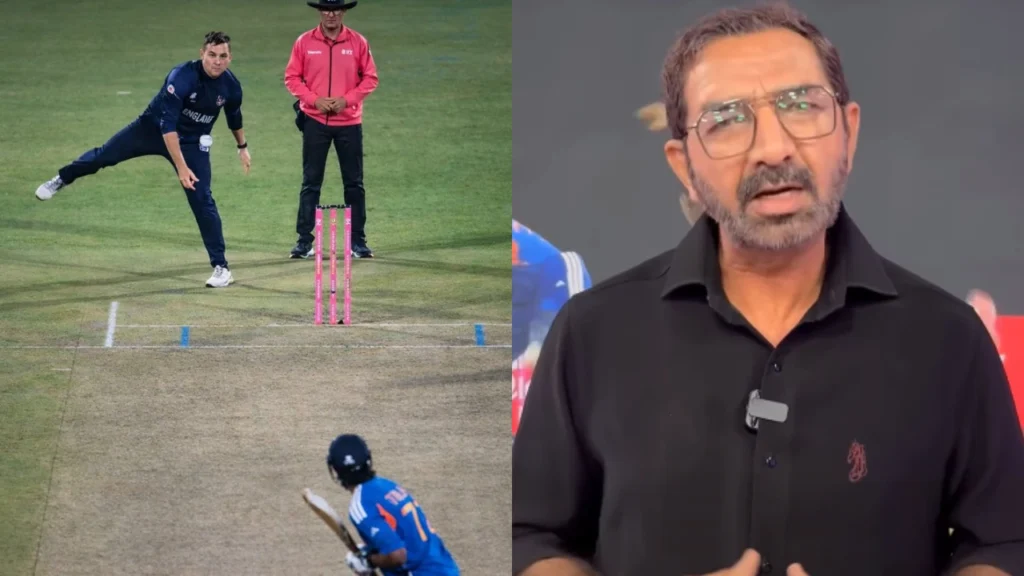
The T20 World Cup 2026 match between India and Namibia turned into high drama after a major on-field brawl at the Arun Jaitley Stadium in Delhi on February 12. Namibia captain Gerhard Erasmus was seen having a heated argument with umpire Rod Tucker during India’s innings.
Gerhard Erasmus’ heated exchange before Tilak Verma’s wicket sparks controversy in T20 World Cup 2026
This incident happened in the eighth over of the Indian innings. Gerhard Erasmus tried to bowl the ball too early in the run-up and from far behind the crease. On-field umpire Rod Tucker immediately declared it a dead ball. This decision shocked the Namibian captain.
Erasmus showed visible frustration on the field, having a heated argument with the umpire as he was forced to bowl again. Later in the same over, Erasmus bowled again from behind the crease. This time, the ball was allowed. He dismissed Tilak Verma and the wicket stood.


Also read: Suryakumar Yadav praised Sanju Samson and Ishan Kishan after the win over Namibia.
This caused confusion among fans as the first ball was ruled dead, but the second was accepted. A rapid debate broke out on social media. Many people raised questions as to why different decisions were taken on two similar deliveries.
dead ball drama explained
Now former ICC umpire Anil Chaudhary told about this drama. Chaudhary said that under ICC rules the bowler is allowed to bowl from behind the crease. He also said that the angle is checked from behind with the new auto no-ball system.
“First let me tell you the rules. A bowler can bowl from behind; there is no problem in that. And now, there is a new protocol. In auto-no-ball, if you do side-cutting from behind, it can be seen. But this is the first time,” Anil Choudhary said in a video posted on his Instagram.
The former umpire also felt at first that Tucker would not be ready, and so he called it a dead ball, but after discussion, everyone was ready, so the next ball was given fairly. The commentator explained further. “When Gerhard Erasmus bowled from behind, Rod Tucker was probably surprised, and he himself was unprepared.
He called the dead ball and he can do that. In the second case, because it had been discussed and the bowler had said that he could bowl from behind, everyone was mentally prepared for it. He also bowled from behind. And the batsman played both the balls properly. The batsman did not face any problem on both the balls. So, the next ball was a fair ball.”
Also read: Ravichandran Ashwin reveals anti-Usman Tariq plan, but claims India’s batsmen lack courage
Erasmus’ action is valid, Tilak Verma’s wicket is valid: Choudhary
Choudhary also insisted that there was nothing illegal in the bowling action of Gerhard Erasmus and that Tilak Verma’s wicket was fine. He also said that if the umpire feels that he himself is not ready then he can call a dead ball, but since the auto-no-ball comes, the angle of side-cutting from behind is covered.
He signed off by saying, “So, I think it’s okay if you don’t bowl a dead ball. But still, we must respect the umpire’s opinion. In both cases, according to me, the ball was fair, and the bowler can bowl from behind. There was nothing illegal in the action of Gerhard Erasmus. And the wicket of Tilak Verma was legal and correct.”
